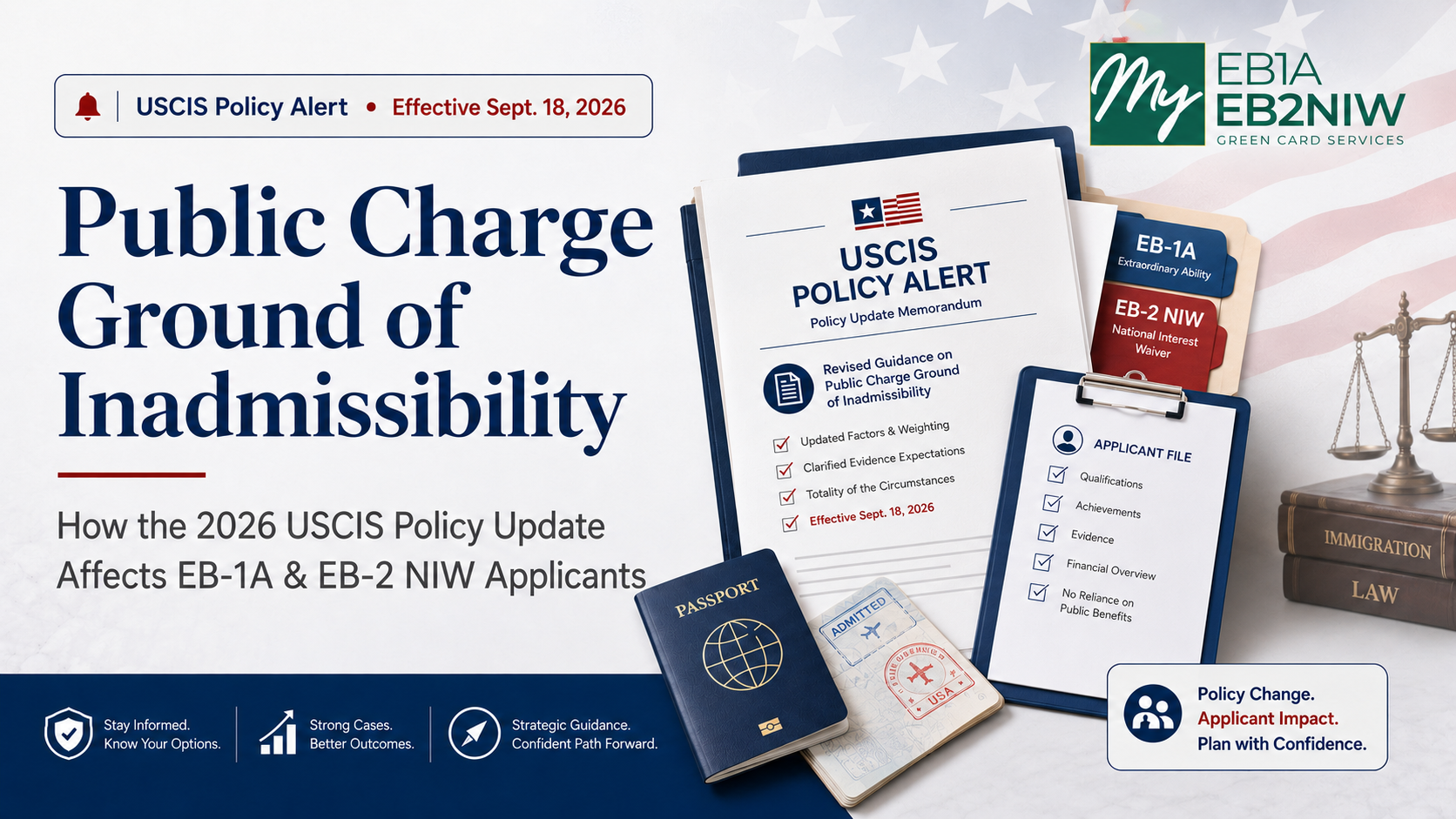
On August 18, 2026, USCIS issued Policy Alert PA-2026-09 and revised Volume 8, Part G of the Policy Manual in its entirety. The guidance takes effect September 18, 2026.
If you are an EB-1A or EB-2 NIW petitioner with a pending or planned Form I-485, one date now governs which rulebook grades your case. Here is what changed, what did not, and where a strong petition can still run into trouble.
What the filing date controls
The new guidance applies to any Application to Register Permanent Residence or Adjust Status (Form I-485) postmarked or electronically submitted on or after September 18, 2026.
Applications filed before that date are adjudicated under the framework in place when they were submitted:
- Postmarked on or after December 23, 2022 but before September 18, 2026 → the 2022 Final Rule
- Postmarked before December 23, 2022 → the 1999 Interim Field Guidance
The rescission behind the new guidance
The 2026 Final Rule, published July 20, 2026 at 91 FR 45324, rescinded the 2022 Final Rule as it applied to public charge inadmissibility determinations and revised the regulations on breach and cancellation of public charge bonds. PA-2026-09 is the policy guidance that follows that rescission.
The new Part G also supersedes the 1999 Interim Field Guidance and related prior guidance on public charge inadmissibility. The framework returns to the statute itself, INA 212(a)(4), and to the precedent decisions interpreting it, rather than to a regulatory definition layered on top.
Two things follow. First, USCIS has not defined “likely at any time to become a public charge” by rule, though the guidance supplies a working formulation: an applicant is generally considered likely to become a public charge if likely to become dependent on the government to meet basic needs such as shelter, food, or healthcare, typically shown through dependence on means-tested public benefits. DHS interprets likely to mean more likely than not.
Second, and easy to miss: the old framework asked whether an applicant was likely to become primarily dependent on the government for subsistence. USCIS has expressly abandoned that threshold, calling it “not the best implementation” of the statute. Even where the benefit categories under review are the same, the standard applied to them is not.
The benefits change, in two timelines
Here is the mechanical heart of the new guidance, and the part worth reading twice.
Benefits received before September 18, 2026
Officers consider only two categories:
- Public cash assistance for income maintenance
- Long-term institutionalization at government expense
Receipt of most other means-tested benefits before September 18, 2026 does not enter the analysis. One caution: long-term institutional care paid for by Medicaid falls squarely inside the second category. “Medicaid” is not a single answer.
Benefits received on or after September 18, 2026
Officers consider any and all means-tested public benefits, and the guidance states that consideration is appropriate irrespective of the time frame of receipt.
That said, officers are also directed to weigh the amount, duration, and recency of receipt, and the hypothetical scenarios in the guidance repeatedly discount old, small, or circumstantial receipt. Distant history is considered; it is not treated as decisive.
What counts as a means-tested public benefit
Neither the statute nor a regulation defines the term for public charge purposes. The guidance tells officers that a benefit is generally considered means-tested if eligibility turns on the applicant’s income or assets falling below a threshold, and generally public if payments or assistance come from a government agency or appropriated government funds.
Examples the guidance identifies, expressly “not limited to” this list:
- Cash assistance
- Public or assisted housing
- Food assistance
- Government-funded health coverage
- Financial aid for postsecondary education
- Any other similar benefit provided to an individual, household, or family eligibility unit
Excluded as earned benefits:
- Social Security retirement and disability benefits
- Medicare
- Unemployment insurance
One trap here. Supplemental Security Income is means-tested and appears on the guidance’s own benefits table, and the precedent the guidance cites includes a decision finding SSI recipients excludable. Do not read “Social Security is not counted” as covering SSI.
A note for the research community (our analysis, not the guidance’s). Postsecondary financial aid appears on the examples list without qualification. Applying the two prongs the guidance sets out, aid awarded on academic merit by a private institution satisfies neither: eligibility does not turn on income below a threshold, and endowment funds are not government funds. Need-based aid drawn from a government program is a different matter, and a merit-labeled state program with an income cap could satisfy the test. Postdocs, graduate researchers, and academics on the EB-1A or NIW track should identify the funding source and the eligibility basis rather than the label.
Receipt, applications, and approvals
Receipt occurs only when the applicant is listed as a beneficiary. USCIS does not attribute a relative’s or child’s receipt to the applicant, and does not attribute benefits the applicant receives solely on behalf of a third party.
Applications and approvals are treated differently from receipt but are still considered when they fall on or after September 18, 2026. Evidence that you withdrew the application or disenrolled is relevant and worth documenting. Note the wrinkle: where an application, certification, or approval covers a period extending beyond September 18, 2026, officers consider what occurs on or after that date. A pre-deadline application is not automatically outside the analysis.
Household benefits reach the analysis through a narrow door. Receipt by a household member is relevant only if those benefits are your source of financial support, or if you are legally obligated to support that person. Even then, the benefit is not attributed to you. The officer considers your income or assets falling below the threshold under the assets, resources, and financial status factor. USCIS does not collect household-member benefit information on Form I-485.
The five statutory factors, and why EB-1A and NIW records perform well
Every public charge determination must weigh five minimum factors under INA 212(a)(4)(B):
- Age: considered in relation to the other factors, including plans for current and future employment
- Health: as reported on Form I-693 by a civil surgeon, including any Class A or Class B conditions
- Family status: including household size
- Assets, resources, and financial status: household income, assets, and liabilities
- Education and skills: degrees, certifications, licenses, English proficiency, and skills obtained through work experience
The fifth factor is where extraordinary ability and national interest waiver records do their own work. An EB-1A petition already documents sustained acclaim. An NIW petition already establishes an advanced degree or exceptional ability plus substantial merit. That evidence maps onto the education-and-skills factor without being rebuilt.
To be precise about what that buys: education and skills is one mandatory factor among five, and the guidance does not say strong credentials carry extra weight. What it does say is favorable. Officers are pointed to precedent holding that an applicant of working age, in good physical and mental condition and capable of earning a living, is generally not likely to become a public charge, even at low income and even where the applicant received certain means-tested benefits.
The self-petitioner position on Form I-864
Most employment-based adjustment applicants are not required to file an Affidavit of Support Under Section 213A (Form I-864). The requirement attaches only when:
- The petitioner is a relative of the applicant, or
- The petitioner is a for-profit entity in which the applicant’s relative holds a significant ownership interest, defined as 5% or more
EB-1A applicants and NIW self-petitioners typically fall outside both conditions.
That matters because of what the guidance says about determinative factors. No single factor decides a case, with one exception. The lack of a sufficient Form I-864, where one is required, requires a finding of inadmissibility. Self-petitioners generally do not carry that exposure, which means every element of their case is weighed in the totality and a strong record can offset a weak data point.
The edge case to check. “Relative” is defined narrowly here: a U.S. citizen or lawful permanent resident spouse, parent, child, or adult son or daughter, or a U.S. citizen brother or sister. An affidavit is not required where the relative is a sibling unless that sibling is a U.S. citizen. If a company filed your I-140 and a qualifying relative holds 5% or more of it, confirm the ownership structure and the relative’s status before assuming exemption.
Where strong cases still get hurt
A qualifying petition is not the same as a clean adjustment record. Four areas deserve a direct look:
Health without coverage. A Class B condition is not disqualifying, and disability alone cannot be the basis for a finding. The pattern the guidance treats unfavorably is narrower and specific: a condition that requires extensive medical care or prevents the applicant from working, combined with insufficient household resources to cover it and no health insurance. Evidence of adequate non-means-tested coverage addresses it directly.
Household benefits tied to your income. Covered above. Know what your household receives, on what eligibility basis, and whether you are legally obligated to support the recipient.
Prior fee waivers. An officer may consider a request for, receipt of, or approval of a USCIS fee waiver in the totality, for adjustment applications filed on or after February 24, 2020. Recency increases the weight. Fee exemptions are a different thing and may not be considered at all.
Income sourced from benefits. Officers exclude income derived from means-tested public benefits from positive consideration. Household income needs to hold up without it.
What happens if a case goes the other way
Two points the coverage of this alert has mostly skipped.
The public charge ground generally cannot be waived for applicants seeking lawful permanent resident status. The narrow exceptions involve S nonimmigrant witnesses and informants and certain aged, blind, or disabled applicants under the legalization program.
Separately, the new guidance builds out the public charge bond process in detail. Four of the alert’s ten policy highlights concern it. An applicant for adjustment who is found inadmissible only on the public charge ground may, in USCIS’s discretion, be invited to post a bond. The guidance covers how officers set the amount and how bonds are maintained, breached, and cancelled. A condition of the bond is that the applicant not receive means-tested public benefits while it remains in effect. It is a fallback, not a plan.
Scope: what this guidance does not cover
PA-2026-09 governs USCIS adjudication of Form I-485. It does not apply to:
- Immigrant or nonimmigrant visa applications before the Department of State
- Applications for admission at ports of entry, which CBP adjudicates
- Adjustment applications before the Executive Office for Immigration Review
If you are consular processing an EB-1A or NIW immigrant visa, INA 212(a)(4) still applies to you. This particular guidance does not control how it is applied.
What to do now
If you are filing near the deadline, treat the date as a deliberate decision rather than a scheduling accident. For most EB-1A and NIW petitioners the framework difference is manageable, and the more productive question is whether the record affirmatively documents self-sufficiency: income and assets, employment continuity, health coverage, and a clean benefits position going forward.
The burden of proof in a public charge determination sits with the applicant and never shifts to USCIS. That is not a reason for alarm. It is a reason to build the record on purpose.
Frequently Asked Questions
Does the new public charge rule make EB-1A or NIW approval harder? Not directly. The public charge ground applies at adjustment of status, not to the I-140 petition. EB-1A and NIW records speak well to the education-and-skills factor, and self-petitioners are usually exempt from the Form I-864 requirement that carries the only outcome-determinative risk. The determination remains discretionary and fact-specific.
I received SNAP or Medicaid two years ago. Does that count against me? Benefits received before September 18, 2026 are considered only if they were public cash assistance for income maintenance or long-term institutionalization at government expense. Ordinary SNAP receipt or routine Medicaid coverage before that date does not enter the analysis. Medicaid-funded long-term institutional care does.
Should I file my I-485 before September 18, 2026? Filing before that date means your case is adjudicated under the 2022 Final Rule. Whether that helps depends on your facts, and filing before you are ready carries its own costs. Discuss the tradeoff with counsel rather than treating the date as a deadline to beat at any price.
Do I need to file Form I-864 as an NIW self-petitioner? Generally no. The requirement applies when a qualifying relative filed the employment-based petition, or when such a relative holds 5% or more of the for-profit petitioning entity. Self-petitioners typically fall outside both.
Does receiving unemployment benefits count? No. Unemployment insurance is treated alongside Social Security and Medicare as an earned benefit and is not a means-tested public benefit. SSI is means-tested and is treated differently.
Can a medical condition alone cause a public charge finding? No. Disability alone cannot be the basis for a finding, and no single factor other than a missing required I-864 is determinative. The concerning pattern is a condition requiring extensive care or preventing work, combined with insufficient resources and no coverage.
Can the public charge ground be waived? Generally not for applicants seeking lawful permanent resident status. In limited circumstances an applicant found inadmissible only on this ground may be invited to post a public charge bond at USCIS’s discretion.
Source: USCIS Policy Alert PA-2026-09, Public Charge Ground of Inadmissibility (August 18, 2026); USCIS Policy Manual, Volume 8, Part G [8 USCIS-PM G]; Public Charge Ground of Inadmissibility, 91 FR 45324 (July 20, 2026).
This article is general information, not legal advice. Public charge determinations are discretionary and made case by case.